
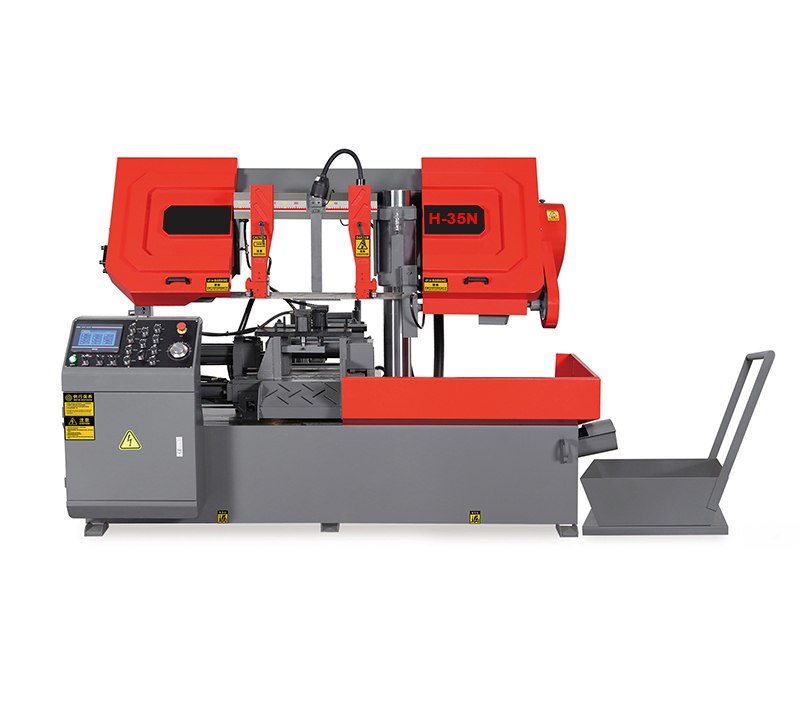
As a pivotal equipment in modern metal processing, CNC band sawing machine are widely used in industries such as mechanical manufacturing, aerospace, and automotive parts production due to their high-efficiency and precision cutting capabilities. By leveraging CNC technology for automated operations, they significantly enhance processing efficiency and accuracy. The following section systematically outlines the core features of CNC band sawing machine from four perspectives: core technologies, functional advantages, application scenarios, and maintenance management.
1.Core Technology Features:
Integration of Intelligence and Automation. The CNC system employs high-performance numerical control systems (e.g., FANUC, SIEMENS) for precise control, supporting programmatic input and automated operation. Users can program cutting paths, speeds, and feed rates to achieve efficient processing of complex contours with cutting accuracy up to ±0.1mm.
The closed-loop feedback system is equipped with displacement sensors and pressure monitoring devices, providing real-time feedback on sawing force, belt saw tension, and workpiece position. It dynamically adjusts cutting parameters to ensure processing stability and minimize human error.
The servo drive system utilizes high-precision servo motors to control the saw frame's lifting and feeding, featuring ultra-fast response (typically ≤0.05 seconds) and stepless speed adjustment. It accommodates cutting requirements for diverse materials including steel, aluminum, and copper.
2.Functional Advantages:
High Efficiency, Flexibility, and Energy Conservation. High-speed Cutting: The band saw achieves speeds of 60-120 m/min, delivering 30%-50% higher cutting efficiency than conventional machine tools.
Continuous processing: Enables multi-piece continuous cutting with automated feeding system for fully automated production.
Flexible multi-angle cutting: The saw frame can rotate ±45 degrees, meeting the requirements for oblique cutting and irregular part processing.
Material compatibility: By adjusting cutting parameters, it can process metal materials with different hardness and cross-sectional shapes (such as pipes, profiles, and solid bars).
Energy-saving and eco-friendly variable frequency speed control technology: automatically adjusts motor power based on load to reduce energy consumption by 15%-25%.
Coolant circulation system: equipped with filtration and cooling devices to reduce coolant waste and minimize environmental pollution.
3.Application Scenarios and Key Advantages:
The batch processing scenario is ideal for mass-producing standardized components (e.g., gear shafts, mold blanks). Programmatic operations minimize manual intervention while ensuring consistent production output.
The system can process complex structures with various cross-sections (e.g., I-beams, channel steel) and variable curvature components, meeting specialized requirements in aerospace, shipbuilding, and related industries.
The precision machining process achieves low roughness (Ra≤3.2μm) by fine-tuning parameters like belt saw tension and feed rate, thereby reducing secondary finishing costs.
4.Maintenance and management: The modular design of key components (e.g., saw blades, guide arms, drive motors) enables quick replacement and maintenance, reducing downtime by over 50%.
The intelligent diagnostic system features a built-in fault self-check program that monitors parameters including band saw wear, motor temperature, and hydraulic system pressure in real time, providing early warnings for potential malfunctions.
The user-friendly interface features a color touchscreen and graphical programming interface, supporting visual parameter adjustment and process simulation. This lowers the operational threshold and improves training efficiency.
5.Limitations and Improvement Directions Limitations:
The cutting efficiency is relatively low for ultra-thick workpieces (>300mm), requiring coordination with other equipment for rough machining.
The saw blade has high consumption cost, especially when cutting cemented carbide, the saw blade needs to be replaced frequently.
Improvement direction: Develop new high-wear-resistant saw blade materials (e.g., tungsten carbide-coated) to extend service life.
The AI algorithm integrates to optimize cutting paths, further reducing energy consumption and material waste.
In conclusion, CNC band sawing machine have become indispensable in modern metal processing, thanks to their intelligent control systems, high-efficiency machining capabilities, and low maintenance costs. With the advancement of Industry 4.0 and smart manufacturing, these machines are evolving toward higher precision and greater flexibility. For instance, they now enable remote monitoring via IoT and fully automated material handling through robotic integration. Looking ahead, CNC band saws will play a more significant role in green manufacturing and complex structure processing, driving the transformation of the manufacturing industry toward smarter and more sustainable practices.
If you have any interest, welcome to contact us via email letiptop@tiptopmfg.comfor a formal quote and talk to LETIPTOP expert to get the support. For more information, please click CNC Band Sawing Machine to view.

 WhatsApp

 8615961618675
 Email
Email